
WhatsApp Marketing for UAE Businesses: The Complete 2026 Strategy Guide

WhatsApp marketing in the UAE is not a trend — it is the default communication channel for a country where more than 90% of the population opens WhatsApp every single day. No other platform comes close to that daily reach, and no other channel delivers a 98% message open rate to go with it. In practical terms, WhatsApp marketing means using the WhatsApp Business platform — its free app or its API — to send targeted messages, automate customer conversations, and convert enquiries into sales faster than email, SMS, or social media ads alone.
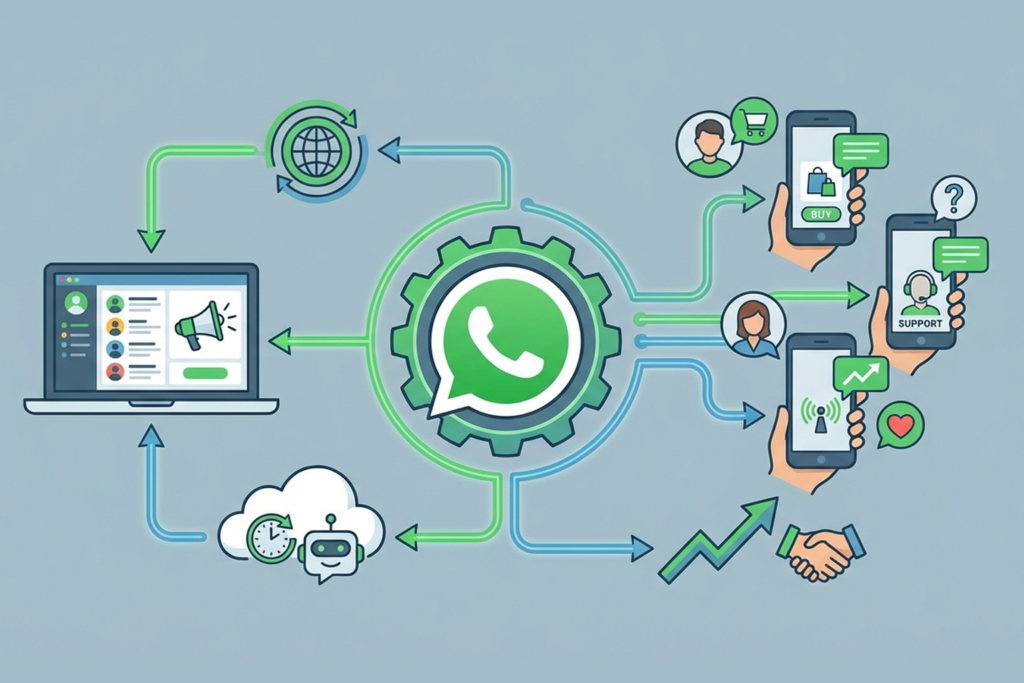
This guide is written specifically for businesses operating in the UAE. It covers why WhatsApp dominates here, how to choose the right tool for your size and ambition, the five campaigns that generate the highest ROI, industry-specific playbooks for real estate through to B2B professional services, and how to stay compliant with the UAE's new Personal Data Protection Law. Whether you're just getting started or you're ready to run at full API scale, you'll leave with a clear plan.

Why WhatsApp Marketing Dominates in the UAE

The UAE is one of the most WhatsApp-saturated markets on earth. According to Meta, over 90% of UAE smartphone users are active on WhatsApp daily, compared to a global average of around 68%. That penetration rate, combined with a tech-savvy, mobile-first population and a culture where personal messaging apps are preferred over phone calls, has made WhatsApp the single most important customer communication channel for UAE businesses in 2026.

The engagement numbers confirm it:

  • 98% open rate — compared to 22–28% for email and 35% for SMS. When you send a WhatsApp message, it gets read.
  • 45–60% click-through rates on links inside WhatsApp messages, versus 2–5% for email marketing campaigns.
  • 72.4% of UAE consumers say they are more likely to complete a purchase when they can communicate with a brand via WhatsApp (Source: Meta Business Messaging Survey, 2025).
  • 3× higher response rate for WhatsApp outreach compared to cold email, and a 21× higher contact rate when businesses follow up within 10 minutes of a lead enquiring.
Beyond raw numbers, WhatsApp fits the UAE's commercial culture in ways other channels don't. B2B relationships here are built on personal communication — and WhatsApp is the medium of personal communication. Real estate agents already close deals on WhatsApp. Doctors' clinics send appointment reminders on WhatsApp. Luxury retailers provide personal shopping on WhatsApp. The infrastructure of trust already exists. The businesses winning in 2026 are those that have systematised it.
WhatsApp's platform architecture also makes it uniquely commerce-ready. Businesses can attach a product catalog, take payments through WhatsApp Pay (in supported markets), deploy AI chatbots that handle the entire sales funnel, and run Meta's Click-to-WhatsApp ads that open a conversation directly from Instagram or Facebook — all within a single channel the customer already trusts and checks multiple times a day.

WhatsApp Business App vs. WhatsApp Business API — Which Do You Need?

Not all WhatsApp marketing tools are equal. The most important decision you will make when launching WhatsApp marketing in the UAE is whether to use the free WhatsApp Business App or the WhatsApp Business Platform (API). They serve different business sizes and ambitions.

Feature WhatsApp Business App WhatsApp Business API
Cost Free AED 0.04–0.18 per conversation
Devices / agents Up to 4 linked devices Unlimited agents via BSP
Broadcast limit 256 contacts per list Unlimited (template messages)
Chatbot / automation Basic quick replies Full flow automation
CRM integration None Full API integration
Green tick verification Not available Available (Meta approval)
Best for SMEs, under 50 chats/day Growing and enterprise businesses

The Free WhatsApp Business App

The WhatsApp Business App is designed for small businesses. It is free, downloadable from the app store, and gives you a dedicated business profile, quick replies, away messages, product catalogs, and broadcast lists of up to 256 contacts per send. For a business handling fewer than 50 conversations per day with no automation requirement, it works well. The primary limitations are the 256-contact broadcast ceiling, the inability to integrate with your CRM or ecommerce platform, and the requirement that broadcast recipients must have saved your number — which means cold outreach is not possible.

The WhatsApp Business Platform (API)

The WhatsApp Business Platform — commonly called the API — is what serious UAE marketing operations use. It has no broadcast limits (subject to Meta's messaging policy and template pre-approval), supports unlimited concurrent agents, integrates with CRM systems, ecommerce platforms, and data warehouses, and enables full chatbot automation for lead qualification, appointment booking, cart recovery, and post-sale support. Unlike the App, the API is not a downloadable application — it is accessed through a Business Solution Provider (BSP), which is a Meta-certified platform that manages the technical layer for you.

Message costs are charged per conversation window (24 hours from the first message), divided into four categories: Marketing, Utility, Authentication, and Service conversations. In the UAE as of 2026, marketing conversation rates sit at approximately AED 0.16–0.18 per 24-hour window, with utility and authentication conversations at AED 0.04–0.06. Most BSPs charge a monthly platform fee on top of Meta's per-conversation cost.

Choosing a BSP for the UAE Market

When selecting a BSP, UAE businesses should prioritise: AED billing (to avoid foreign exchange exposure), Arabic language interface and template support, local data residency or PDPL-aligned data processing agreements, 24/7 Arabic-speaking support, and native integration with UAE platforms (Salesforce, Zoho, HubSpot, and increasingly local ERPs). Whichever BSP you choose, the underlying WhatsApp Business account and green-tick verification status remain yours — you can migrate BSPs without losing your number or your audience.

How to Launch WhatsApp Marketing in the UAE: Step-by-Step

Setting up WhatsApp marketing on the API involves eight sequential steps. Rushing any of them — particularly business verification — is the most common cause of delayed or failed launches for UAE businesses.
Not all WhatsApp campaigns are equal. Based on aggregated performance data from UAE markets, these five campaign types consistently deliver the highest return on investment.
  • Choose your tool and BSP. Decide whether the Business App or the API is right for your current volume. If you are going with the API, shortlist two or three BSPs and evaluate them on the criteria above before committing.
  • Create or verify your Meta Business Manager account. Go to business.meta.com and set up your organisation's Meta Business Manager. This is the admin layer that controls your WhatsApp business account, your ad accounts, and your payment settings.
  • Complete Meta Business Verification. Submit your Trade Licence, bank statement, or official letterhead to Meta for verification. In the UAE, this typically takes 3–7 business days. Some categories (healthcare, finance, real estate) require additional documentation. Do not skip this step — unverified accounts are capped at 250 conversations per day.
  • Register and approve your WhatsApp phone number. Select or port a dedicated UAE (+971) phone number. This number will be your permanent WhatsApp Business identity — it cannot be used on regular WhatsApp after registration. If you are an established business, avoid using a number that customers already message you on personally.
  • Create and submit message templates. WhatsApp requires pre-approval for all outbound messages you initiate (called 'template messages'). Templates must follow Meta's content policy: no all-caps, no excessive emojis, no misleading CTAs. Approval typically takes 24–48 hours, though rejections require revision and resubmission. Have your first five templates ready — a welcome message, a lead follow-up, a promotional broadcast, an appointment reminder, and a cart recovery sequence.
  • Build your opt-in mechanism. You cannot message anyone who has not explicitly opted in — this is both a Meta policy requirement and a UAE PDPL requirement. Build opt-in checkboxes on your website contact forms, add a WhatsApp opt-in to your checkout flow, use Click-to-WhatsApp ads that count as consent, and train your sales team to collect opt-ins on every call.
  • Configure your automation flows. Map out the journeys your customers take: new lead → qualification questions → product recommendation → pricing → follow-up. Work with your BSP or developer to build these flows in the visual builder, test them end-to-end on a staging number, then publish.
  • Launch, measure, and optimise. Go live with a controlled test broadcast to 500–1,000 contacts before scaling. Monitor open rates, response rates, and opt-out rates in the first 48 hours. An opt-out rate above 3% is a signal that your targeting, frequency, or messaging quality needs refinement.

The 5 Highest-ROI WhatsApp Campaigns for UAE Businesses

Not all WhatsApp campaigns are equal. Based on aggregated performance data from UAE markets, these five campaign types consistently deliver the highest return on investment.

1. Click-to-WhatsApp Ads (CTWA)

Click-to-WhatsApp ads are Meta ads — running on Instagram or Facebook — that open a WhatsApp conversation instead of sending the user to a landing page. This is the single highest-leverage WhatsApp campaign for UAE businesses that currently run paid social, and the numbers are striking. A Forrester study commissioned by Meta found that CTWA campaigns generate a 94% lift in conversion rates and a 92% lower cost-per-lead compared to equivalent landing page campaigns. UAE-specific benchmarks show an 81.4% conversation-to-sales-inquiry conversion rate and ROAS between 3× and 8× — versus 1.5–3× for landing pages.

One important technical note: to properly attribute CTWA conversions — and to retarget users who started but did not complete a conversation — you need to have the Conversions API (CAPI) integrated between your WhatsApp BSP and Meta's data layer. Without CAPI, you are running your CTWA ads partially blind.

2. Lead Nurture Sequences

A lead nurture sequence is a structured series of WhatsApp messages sent over days or weeks to warm a prospect from initial enquiry to purchase decision. Unlike email nurture, WhatsApp sequences get read — almost every message, almost immediately. For UAE businesses selling higher-ticket products (real estate, clinics, B2B services, automotive), a well-structured nurture sequence can cut the average sales cycle by 30–40%.

The framework is simple: Day 1 — welcome and value delivery (a useful guide, a free consultation offer, a portfolio piece relevant to their stated interest). Day 3 — social proof (a client testimonial or a brief case study). Day 6 — objection handling (address the top three hesitations your sales team hears most often). Day 9 — urgency or incentive (a limited-time offer or a calendar link to book a call). Day 14 — final follow-up with a clear close or an easy opt-out.

3. Abandoned Cart & Booking Recovery

For e-commerce brands and service businesses that take online bookings, cart and appointment abandonment represents money already in the funnel — just not yet collected. WhatsApp recovery messages outperform email by a significant margin because they arrive in the same app the customer uses to message friends and family. A well-timed WhatsApp message sent within 30 minutes of abandonment, offering a personalised nudge and an easy payment link, recovers an average of 27% of abandoned carts in UAE e-commerce contexts — compared to a 5–10% email recovery rate.

For clinic and salon bookings, WhatsApp appointment reminders sent 24 hours and 2 hours before the scheduled time reduce no-show rates by up to 40%, which is a significant operational saving for any appointment-based business in the UAE.

4. Post-Purchase Loyalty & Review Campaigns

The post-purchase window is underused by most UAE businesses, yet it is the cheapest time to generate a repeat sale, a review, or a referral — because trust is at its highest. A WhatsApp message sent 48 hours after delivery or service completion, asking for a quick review or offering a loyalty reward, converts to a review at 3–4× the rate of the same request sent via email. For businesses in sectors where Google reviews directly influence new customer decisions — restaurants, clinics, beauty salons, law firms — this campaign type alone can materially move your local SEO ranking within 60 days.

Layer on a loyalty programme — a simple 'send this message to your friends and get 15% off your next booking' referral mechanic — and WhatsApp becomes a customer acquisition channel funded by your happiest existing customers, at close to zero cost.

5. B2B Pipeline Follow-Ups

WhatsApp is not only for B2C. In the UAE B2B market — where purchasing decisions are relationship-driven and face-to-face meetings remain central — WhatsApp is already the primary way business contacts communicate. Formalising that into a structured follow-up process delivers outsized results.

Research shows a 21× higher contact rate for B2B follow-up messages sent via WhatsApp within 10 minutes of an initial enquiry, compared to cold email sent at the same time. For proposal follow-ups, a WhatsApp message two days after a proposal has been sent ("Just checking you have everything you need — happy to jump on a 10-minute call if you have questions") reads as human and attentive rather than automated and intrusive. Combined with a robust SEO strategy in Dubai to feed inbound leads into the top of this funnel, B2B WhatsApp becomes a powerful conversion layer at every stage of the pipeline.
Layer on a loyalty programme — a simple 'send this message to your friends and get 15% off your next booking' referral mechanic — and WhatsApp becomes a customer acquisition channel funded by your happiest existing customers, at close to zero cost.

Industry Playbooks: WhatsApp Marketing by Sector in the UAE

The UAE's business landscape is unusually diverse — real estate developers, luxury retailers, quick-commerce apps, healthcare groups, and multinational B2B firms all operate in the same city and often compete for the same customer attention. What works for a DTC e-commerce brand does not necessarily work for a clinical healthcare group. Here are the playbooks that work by sector.

Real Estate

Real estate is one of the highest-performing WhatsApp verticals in the UAE, with off-plan developers and agency brokerages both running sophisticated WhatsApp programmes. The typical journey: a prospect sees a Facebook or Instagram ad for a Dubai Marina development → taps a CTWA button → receives an automated WhatsApp message with a digital brochure, a payment plan summary, and a link to book a showroom visit → is handed off to a human agent when they confirm interest. This sequence, when properly built, converts at significantly higher rates than the equivalent email-and-phone-call approach.

Key tactics specific to UAE real estate: send floor plans and payment plan documents via WhatsApp instead of email (they get viewed immediately). Use broadcast lists segmented by investor budget and nationality. Add RERA registration numbers and DLD-compliant disclosures directly into message templates. Set up Oqood registration notification automations for off-plan buyers so that every milestone in their ownership journey is communicated proactively — this builds trust and dramatically reduces post-sale enquiry volume for your sales team.

Retail & E-commerce

UAE retail — both physical and online — is heavily influenced by seasonal promotions. Flash sale announcements sent via WhatsApp to opted-in customers consistently outperform equivalent email announcements by 3–5× on conversion rate, simply because the message arrives in a more trusted environment. For brands selling on platforms like Noon or Namshi alongside their own website, WhatsApp can serve as the direct-to-consumer loyalty channel that keeps customers coming back to your owned store rather than the marketplace — where you lose data, margin, and brand relationship. Cart recovery (covered above), post-purchase review requests, and win-back campaigns for customers who have not purchased in 90 days are the three highest-ROI automations for UAE e-commerce on WhatsApp.

F&B & Hospitality

Restaurants, hotels, and experience businesses use WhatsApp for reservation confirmation, menu sharing before arrival, upselling add-ons (the private dining room, the sunset yacht extension), and post-visit feedback collection. UAE hospitality brands see particularly high engagement on WhatsApp around iftar promotions during Ramadan, where a well-timed broadcast to opted-in guests two weeks before Ramadan begins — offering early reservation for the iftar set menu — sells out reservations faster than any other channel. The WhatsApp Business Catalog feature is underused in UAE F&B. Uploading a digital menu to your WhatsApp Business account means that when customers ask what is on your menu, the answer is a tappable visual catalog -- not a PDF that opens slowly in the browser.

Healthcare & Clinics

UAE healthcare groups and private clinics operate in a high-trust, high-compliance environment. WhatsApp is already the way UAE patients prefer to communicate — the question is whether to formalise it. Best practices: appointment reminders via approved WhatsApp templates (reducing no-shows by 40%), lab result notifications that direct patients to a secure portal rather than including sensitive data in the message itself, post-consultation follow-up messages checking on recovery, and reactivation messages for patients who haven't booked a follow-up within the clinically recommended timeframe. Healthcare businesses must pay particular attention to PDPL compliance (see the compliance section below) — patient data is a special category under the law, and consent records must be maintained rigorously. Never send clinical information in a WhatsApp template — keep those messages in a secure, audited patient portal and use WhatsApp only for logistics and relationship touchpoints.

Professional Services & B2B

For consultancies, law firms, accountancies, logistics companies, and tech firms selling to businesses rather than consumers, WhatsApp marketing is less about broadcast and more about structured one-to-one communication at scale. The highest-impact implementations in UAE B2B are: automated proposal follow-up sequences (as described above), onboarding workflows for new clients that deliver welcome documents, introductory contacts, and key deadlines via WhatsApp over the first 30 days, and retainer check-in messages that create monthly touchpoints without requiring the account manager to remember to send them manually.
B2B businesses should also consider WhatsApp as an integrated layer within their broader digital marketing — the channel that converts leads generated by social media management and organic search into qualified pipeline conversations.

Frequently Asked Questions

Is WhatsApp marketing legal in the UAE?
Yes — WhatsApp marketing is legal in the UAE, provided you comply with two sets of rules: Meta's Business Messaging Policy and the UAE Personal Data Protection Law (PDPL). The core requirement of both is explicit, documented opt-in consent from every recipient before you message them. You cannot purchase contact lists or message people who have not specifically agreed to receive communications from your business. If you follow the consent and opt-out rules, WhatsApp marketing is not only legal but is the most effective direct marketing channel available in the UAE.
Costs depend on whether you use the free Business App or the paid API. The WhatsApp Business App is free, but limited. The WhatsApp Business Platform (API), accessed through a BSP, involves two layers of cost: Meta's per-conversation charges (approximately AED 0.16–0.18 for marketing conversations, AED 0.04–0.06 for utility conversations as of 2026), and a BSP platform fee typically ranging from AED 300 to AED 1,500 per month depending on your monthly conversation volume and the features you need. At scale, WhatsApp cost-per-acquisition is typically 40–60% lower than equivalent email marketing, making it cost-effective even with API pricing.
The WhatsApp Business App is a free mobile application for small businesses — it supports up to four linked devices, basic automated replies, and broadcast lists of up to 256 contacts. The WhatsApp Business Platform (API) is an enterprise-level communication infrastructure that supports unlimited agents, unlimited broadcast scale (subject to template approval and quality rating), full automation, CRM integration, and the green verification tick. The API is not a downloadable app — it is accessed through a certified BSP that manages the technical integration for you.
Click-to-WhatsApp ads are standard Meta ads (appearing on Facebook or Instagram) with a "Send Message" call-to-action that opens a WhatsApp conversation with your business instead of sending the user to a website or landing page. When the user taps the button, a pre-filled opening message is sent on their behalf, starting the conversation. Because the user initiates the conversation, this counts as opt-in consent under both Meta policy and UAE PDPL. CTWA ads consistently outperform landing page campaigns in the UAE, with documented ROAS of 3–8× and a 92% lower cost-per-lead in Forrester research commissioned by Meta.
The most effective opt-in building methods for UAE businesses are: (1) CTWA ads — users who click these have implicitly opted in by starting the conversation; (2) website form checkboxes with clear consent language; (3) QR codes in-store, in restaurant menus, or in print collateral that open a WhatsApp conversation; (4) verbal opt-in collected by sales staff (documented in your CRM with timestamp); and (5) existing customers who receive a one-time WhatsApp invitation to opt into your communications list. Never add contacts without their explicit consent — this is the most direct route to account suspension and a PDPL violation.
You can send bulk messages on WhatsApp, but only through the WhatsApp Business Platform (API), not the standard Business App (which is capped at 256 per broadcast list). Via the API, your daily messaging limit is determined by your account's messaging tier — starting at 1,000 business-initiated conversations per day and scaling to unlimited as you demonstrate consistent quality (measured by delivery rate, read rate, and low opt-out and block rates). All bulk outbound messages must use pre-approved message templates and be sent only to opted-in contacts. Cold bulk messaging to purchased lists is prohibited and will result in permanent account suspension.
Posted in Blogs